






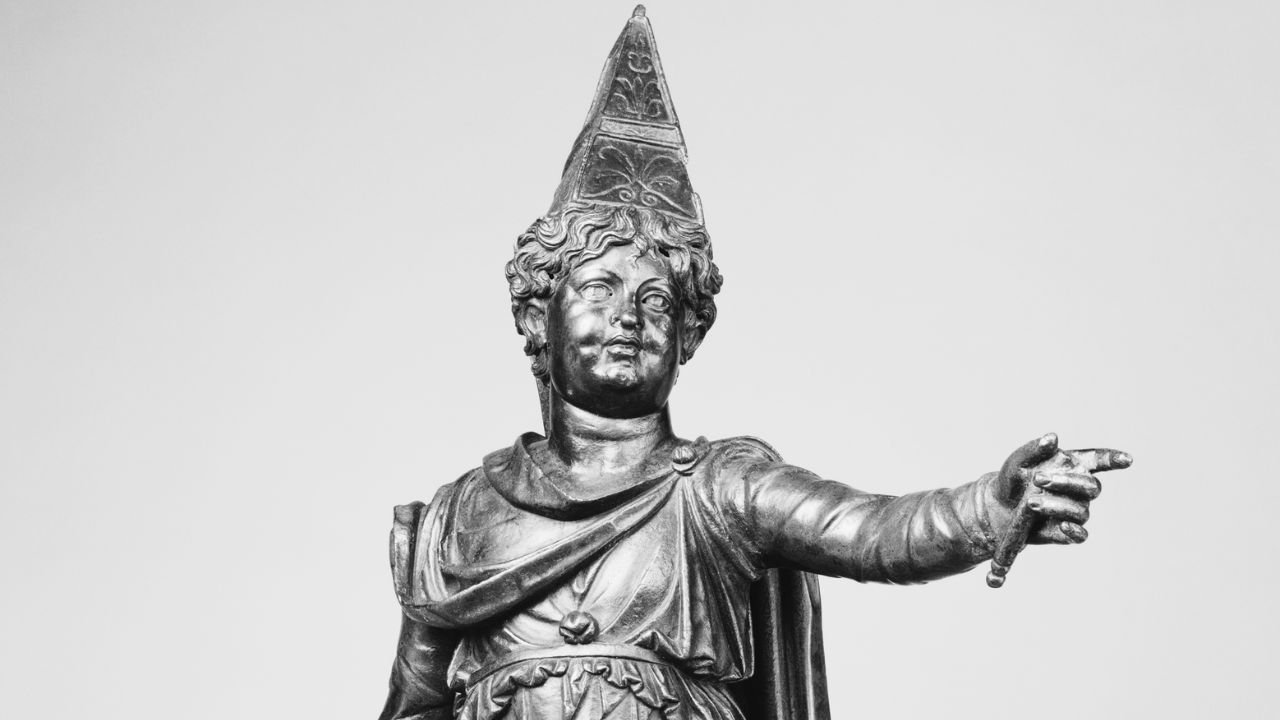
Hey there, history buffs and curious minds! Have you ever wondered about the mysteries lurking in the shadows of the ancient world, especially those involving powerful figures with lineage fit for legends? Well, today we’re diving into the mysterious saga of Alexander Helios, a Ptolemaic prince with a name that echoes like a whisper from the past. Picture this: he’s the eldest son of Cleopatra VII and Mark Antony, wow, right? So, what if I told you that this intriguing figure just vanished from history? Let’s unravel the enigma of Alexander Helios, shall we?
Identity and Heritage
First things first, let’s get to know who Alexander Helios was. With a name like that, you know there’s a story tucked in there, waiting to be uncovered! Here’s the thing: “Alexander” is a head-nod to none other than Alexander the Great himself—talk about legacy! Cleopatra was big on heritage, being part Macedonian and all. Now, “Helios?” It means “Sun” in Greek. Fun twist, huh? It complements his twin sister Selene, which, you guessed it, means “Moon.” It’s like they were celestial twins designed to shine (literally!) and reflect glory.
Let’s not forget his powerhouse family. Helios was the son of Cleopatra VII, the last reigning queen of Ptolemaic Egypt, and Mark Antony, the Roman triumvir and legendary figure in his own right. His siblings include Cleopatra Selene II, his twin, and Ptolemy Philadelphus, his younger brother. Plus, there’s Ptolemy XV Caesar, famously known as Caesarion, Cleopatra’s son with none other than Julius Caesar. Talk about an illustrious heritage mingling the might of Macedonian Greek and Roman bloodlines. No wonder historians drool over this family tree!
Birth and Upbringing
Let’s picture the grand setting of Alexandria on December 25, 40 BC. Alexander Helios made his debut into the world amid opulence and power. His upbringing was nothing short of royal, in the heart of the Ptolemaic court, surrounded by the finest scholars of the time. Imagine little Helios paddling around the palace, soaking up knowledge like a sponge.
His early years were spent drifting through Alexandria’s corridors of power, meeting his father, Mark Antony for the first time at just around three years old. What a sight that must have been! Picture Antony, with the weight of Rome on his shoulders, encountering this curious little tot—his own flesh and blood. Despite the cordial meeting, the political winds were always tempestuous, hinting at the challenges that lay ahead in little Helios’ life.
Political Role and Titles
Now, here’s where it gets interesting! In 34 BC, during the grand ceremony known as the Donations of Alexandria, young Helios received a title that was beyond impressive: “King of Kings.” It sounds like something out of an epic tale, but the reality was quite the spectacle. Cleopatra and Antony were playing a high-stakes game, throwing titles like confetti to showcase their might.
In this lavish ceremony—oh, you should have seen it!—Alexander Helios was ceremonially granted territories encompassing Armenia, Media, Parthia, and even lands “yet to be discovered” between the Euphrates and Indus Rivers. The catch? These territories weren’t actually under his control. They were more in the realm of symbolic declarations, a bit of ancient-world pageantry designed to dazzle, but filled with empty promises as those lands belonged to other rulers.
Engagement and Diplomatic Alliances
At about the same time, Helios was betrothed to Iotapa, a princess from Media Atropatene. You could say it was the matchmaking of the millennium, all orchestrated to forge a heavy-weight political alliance. But, as history tends to do, plans unraveled. When Antony’s fortunes took a nosedive and tragedy struck his family, the betrothal was essentially scrapped, leaving our young prince without a dynasty to link with.
After the curtain fell on his parents’ aspirations, Iotapa returned to her family and later married King Mithridates III of Commagene. It’s like those scenes where one minute everything seems perfectly aligned, and the next, the pieces don’t fit at all.
Fall of His Parents and Capture
Fast forward to 31 BC, where the Battle of Actium marks a turning point on a scale worthy of its own epic. Picture Antony and Cleopatra on one side and the young, cunning Octavian (later Augustus) on the other. Spoiler alert: Antony and Cleopatra didn’t win. Instead, they faced a devastating defeat, with Antony taking his life by a suicide wound and Cleopatra succumbing—legend says—to the bite of an asp.
Now imagine this: Alexander Helios, no longer in his mother’s arms, was swept into the storm of his family’s downfall. Octavian, perhaps with one eye on posterity and the other on politics, captured young Helios and his siblings, whisking them off to Rome. Transported under the vigilant gaze of an emperor-to-be, their futures became muddied by uncertainty and imperial agendas.
Public Display in Rome
This brings us to one of the most dramatic spectacles in history: Octavian’s triumph in 29 BC. Picture the grandeur of Rome, its streets teeming with spectators as the vanquished children of royalty are paraded in chains. Imagine Alexander Helios and Cleopatra Selene II, clad in heavy golden chains, their shame displayed to the masses.
It’s a fever-dream of symbolism—one that marks the fall of a dynasty. This parade wasn’t just a declaration of victory but a flashing neon sign that screamed: Rome had prevailed over the East. Behind their mother’s effigy holding an asp, the siblings stood as living relics of what was, and what could never be again.
Mystery of His Fate
Here’s the crux: after the spectacle, history kind of left Alexander Helios hanging. Silence enveloped his story as if the pages of his life were torn away. There are no definitive records after this glorious parade, which gives rise to endless speculation!
Some historians suggest that he might have died between 29 and 25 BC—young and overshadowed by Rome’s dominance. Maybe he fell ill, or was perhaps cared for by Octavia, Octavian’s sister and Antony’s former wife. Yet, no evidence stamps his fate. It’s like trying to find a shadow on a moonless night.
Cultural Legacy
Even in his disappearance, Alexander Helios shines on! His tale echoes in literature like “Cleopatra’s Daughter” penned by Michelle Moran, showcasing him as part of a gripping narrative revolving around Cleopatra Selene’s life in Rome. Helios might have slipped through the cracks of recorded history, but his legacy as Cleopatra’s mysterious son fuels endless curiosity.
The academic world hasn’t let go either, with countless scholarly ventures exploring the political machinations of his lineage, and how his story entwined with the great rivalries and alliances of antiquity.
Conclusion
So what do you think now, having peeked behind the curtains of history? The unsolved mystery of Alexander Helios—it’s intriguing, isn’t it? His story is just one thrilling chapter in the annals of ancient history, one that beckons us to ponder about those long gone and whose stories remain whispers in time.
So, the next time you encounter another ancient mystery, remember Alexander Helios and the legacy he left behind—not by deeds or conquests, but by simply being part of one of the most illustrious lineages in history. Here’s a link for more intriguing stories! Who knows what you might uncover!
Also Read: